This article has been authored by Afnaan Siddiqui (Co-founder and Partner) and Visakha Raghuram (Associate).
UNDERSTANDING THE REVERSE FLIP:
Of late, a significant trend has emerged within the Indian corporate landscape: the “Reverse Flip.” India’s burgeoning startup ecosystem has become a fertile ground for innovation and growth, attracting companies to relocate their headquarters back to Indian soil. There are some notable examples done in recent years, such as Dream11, Zepto, PhonePe, and Groww, etc. are at the forefront of this movement, having successfully re-domiciled their operations to India.
In order to understand what reverse flipping is, it is important to understand that the erstwhile practice of “flipping” in the Indian startup realm, whereby the entire Indian entity transfers its assets to the foreign entity by becoming a wholly owned subsidiary of a company domiciled in a foreign country, while still retaining most of its market, personnel, and founders in India.
The “Reverse Flipping” is a process whereby companies that have moved or incorporated their headquarters abroad to enjoy tax, regulatory and other benefits, choose to relocate their home soil. It involves companies shifting their headquarters from foreign jurisdictions back to India, motivated by strategic, regulatory, and financial advantages.
WHY REVERSE FLIPPING IS GAINING TRACTION?
The regulatory landscape in India has evolved to accommodate and encourage this shift. As per the applicable Rule(s) of the Companies (Compromises, Arrangements and Amalgamations) Rules, 2024 (“CAA Rules”), for ease, a concept of deemed approval from the Reserve Bank of India (RBI) was introduced earlier. Additionally, now these transactions are also eligible to be carried out through the fast-track merger mechanism provided under Section 233 of the Companies Act, 2013, thereby further expediting the process and simplification of re-domiciling of Companies having their headquarters overseas back to India.

BENEFITS OF CONSIDERING REVERSE FLIP:
- Tax Incentives: The transfer of Capital Assets of the Foreign Holding Companies (H Co.) to the Indian Subsidiary Company (S Co.) as well as the transfer of shares by the Non-Resident Shareholders in lieu of shares of S Co. are not subject to as capital gain tax under Section 47(vi) and (vii) of the Income Tax Act, 1961. Additionally, the tax losses of the H Co. would become the loss of S Co., subject to the conditions outlined in Section 72A of the Income Tax Act, 1961.
- Operational Efficiency: Reverse flipping or re-domiciling can improve the operational efficiency for Companies planning for an IPO. This is achieved by providing easier access to the capital market in India through listing on recognised stock exchanges and potentially achieving better valuations in the Indian market. The trend of reverse flipping has been fuelled, with many companies shifting their domiciles back to India from overseas jurisdictions.
- Potential Cost & Time Reduction: Reverse flipping can be a more cost-effective approach and can significantly reduce the time to go public, allowing companies to seize market opportunities more quickly than they would.
- Encouraging Investment & Higher Net Worth: When Companies relocate their headquarters back to India after initially setting up overseas, it aligns with the government initiatives such as Production Linked Incentives (PLI) and Start Up India. This creates a more favourable business environment that encourages repatriation. As a result, reverse flipping can contribute to the development of a higher net worth through re-domiciling in India.

THE REVERSE FLIP TREND:
In the most recent cases, many companies have succeeded in redomiciling to India. The following are some notable examples:
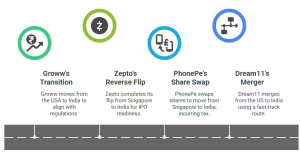
- Dream 11: Dream Sports, the parent company of Dream11, has successfully shifted its domicile from Delaware, US, to India through a reverse merger. The reverse flip was carried out under the fast-track cross-border merger route, introduced by the Indian government in September 2024. This will allow the foreign holding company to merge with its Indian subsidiary without requiring National Company Law Tribunal (NCLT) approval. Instead, companies only need clearance from the Regional Director of the Ministry of Corporate Affairs, significantly reducing the time for completion.
- Zepto: Zepto has completed a reverse flip from Singapore to India to become an Indian parent entity ahead of its proposed IPO. The NCLT had approved the merger of Singapore-based Kiranakart Pte Ltd with Kiranakart Technologies Ltd, thus bringing the domicile of Zepto’s holding company to India.
- PhonePe: Walmart backed PhonePe had completed its reverse flipping from Singapore to India through a swap of shares, incurring approximately $1 billion (INR 10,000 crore) tax payout in India. The move involved significant financial implications, including a substantial tax liability. PhonePe’s investors had to pay around INR 8,000 crore in capital gains taxes to facilitate the shift. The transition also included migrating all of PhonePe’s businesses and subsidiaries, such as its insurance broking and wealth broking services, to India.
- Groww: The fintech startup Groww moved its domicile transition from the USA back to India in March 2024. The move was driven by the desire to align with the Indian regulatory requirements and benefit from the supportive ecosystem for fintech companies in India.
REVERSE FLIP: A FUEL TO INDIA’S ECONOMIC GROWTH
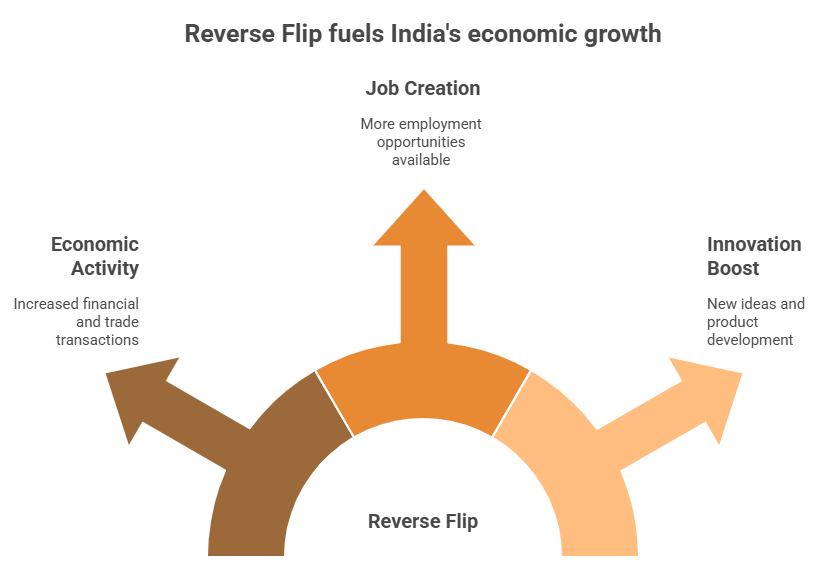
The Indian government’s continuous efforts to enhance the ease of doing business and provide supportive policies will likely further fuel this trend, positioning India as a formidable player in the global corporate arena. The Reverse Flip trend signifies a positive shift in India’s business environment and highlights the country’s growing attractiveness as a global business hub. As more companies consider relocating their headquarters back to India, the nation stands to benefit from increased economic activity, job creation, and innovation. A well-planned approach will ensure that the benefits of shifting back to India outweigh the challenges and lead to a successful transition.